x86-64 Assembly: Local Variables, Stack Frames & Alignment Explained

x86-64 Assembly: Local Variables, Stack Frames & Alignment Explained

Learn how local variables are allocated on the stack in x86-64 assembly using YASM. See exactly how to reserve space, address variables with offsets, understand downward stack growth, and fix mysterious printf segfaults caused by 16-byte stack misalignment. Includes two alignment solutions and a complete working example with a local integer array.
Mixed Function Arguments in x86-64 Assembly – Integers & Floats Explained

Mixed Function Arguments in x86-64 Assembly – Integers & Floats Explained

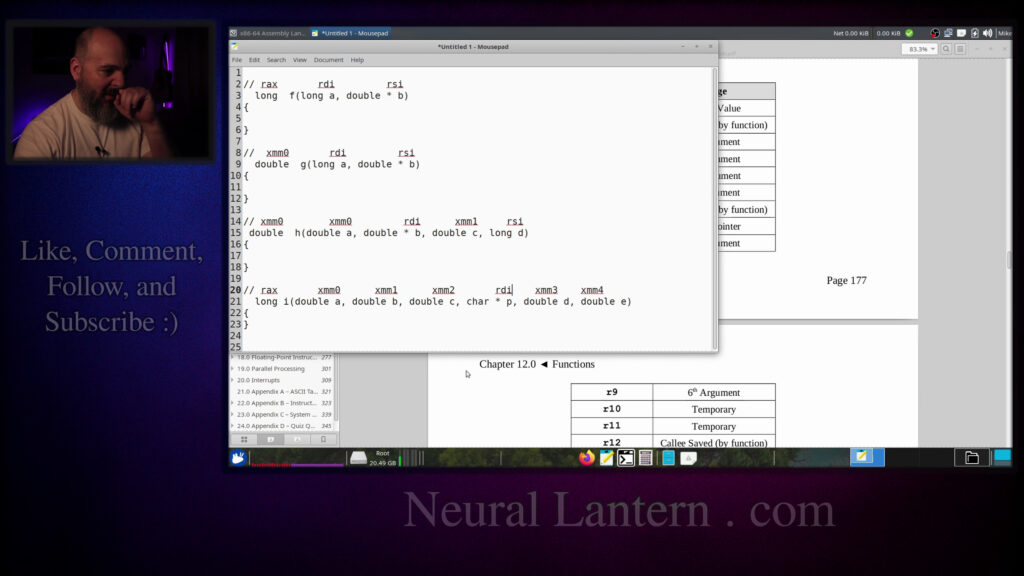
In the System V x86-64 ABI, integer and floating-point arguments use separate register assignment sequences. Integer arguments go into rdi, rsi, rdx, rcx, r8, r9 (then stack), while floating-point arguments use xmm0 through xmm7 independently. This means the first integer you see — even if it appears after several doubles — always goes into rdi, and the second float always goes into xmm1 regardless of how many integers came before it.
x86-64 Assembly: Integer Data Movement, Pointers, and Dereferencing Explained (YASM on Ubuntu)

x86-64 Assembly: Integer Data Movement, Pointers, and Dereferencing Explained (YASM on Ubuntu)

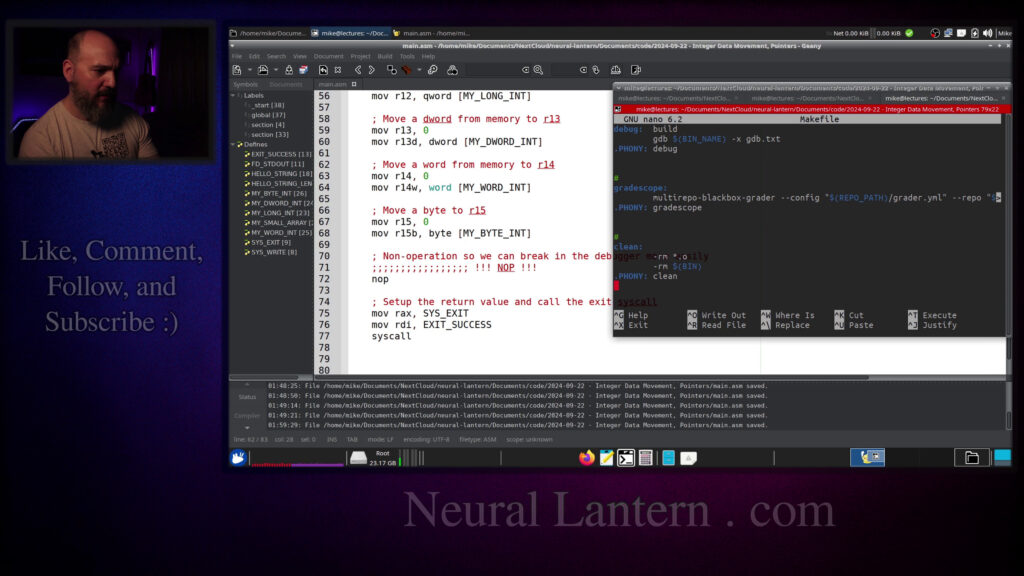
This practical x86-64 assembly language tutorial explains integer data movement between registers and memory, the importance of data size specifiers (byte, word, dword, qword), the difference between pointers and dereferenced values, pointer arithmetic for array access, and using LEA for address calculation - all demonstrated with YASM on Ubuntu Linux and inspected via GDB.